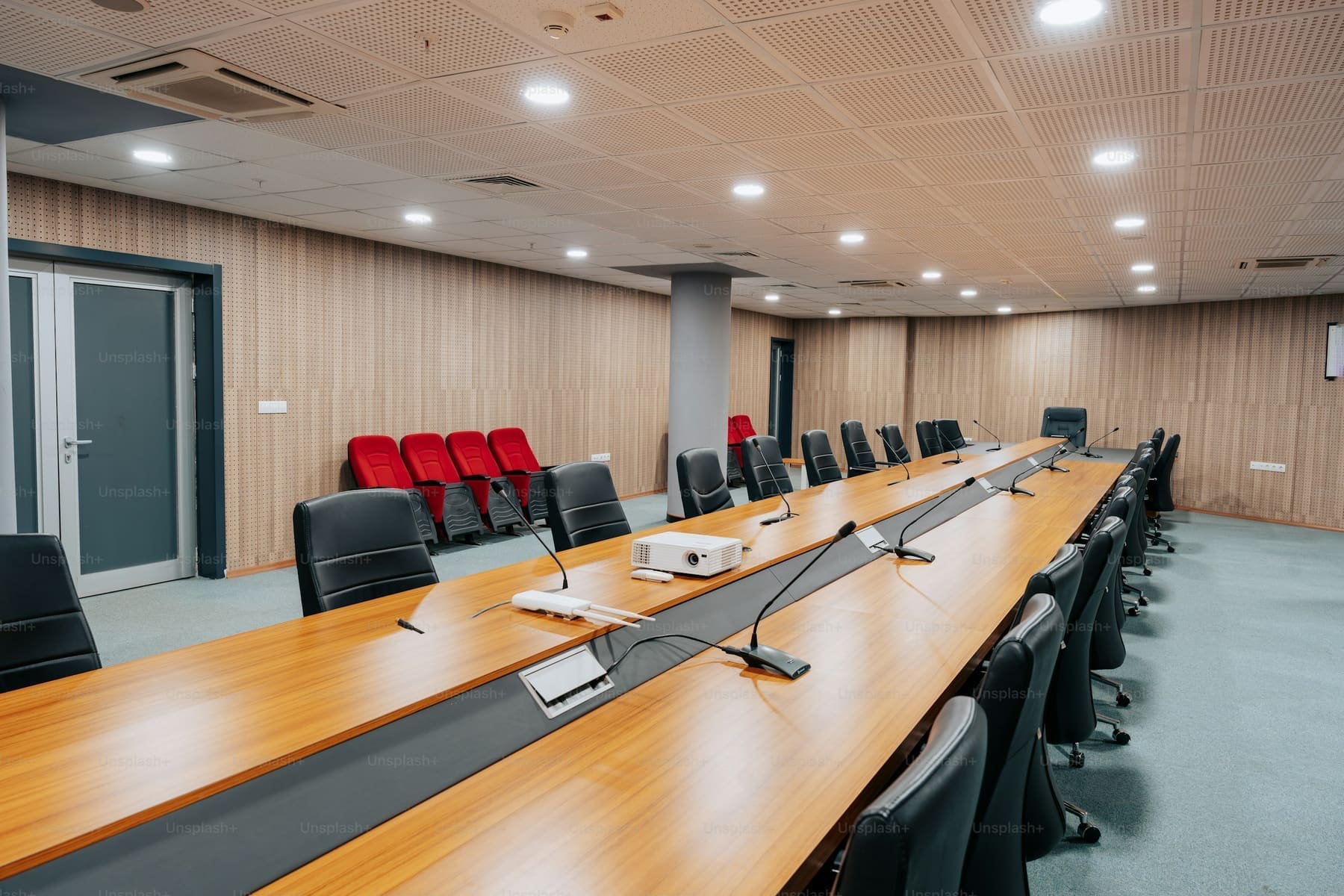
Most meeting room projects go wrong in the same way: somebody picks the display first, because it is the most visible purchase, and everything after that is a compromise around a decision that should have come fourth. Room size, sightlines and acoustics come first. The hardware follows from them.
Start with the room, not the catalogue
Measure the space and count the seats. A room for six people at a single table is a fundamentally different problem from a room for sixteen across a horseshoe — not because the equipment is better, but because the microphone coverage, the camera field of view and the furthest viewing distance all change together.
Three measurements settle most of the specification: the distance from the display to the furthest seat, the ceiling height, and the position of the primary light source relative to where people sit.
Size the display from the furthest seat
The practical rule for content legibility is that the display's diagonal should be roughly a sixth of the distance to the furthest viewer. A seat twelve feet back wants a 75-inch panel, not the 55-inch that looks generous in an empty room.
Beyond about twenty feet, or in rooms with significant ambient light, a single panel stops being the answer and you are choosing between a large-format LED wall and a laser projector. Both work; the deciding factor is usually whether the room can be darkened and whether there is wall depth to spare.
Then solve audio, which is where rooms actually fail
Remote participants forgive mediocre video. They do not forgive audio they have to strain through. In a room up to about twelve people, an all-in-one video bar with a built-in beamforming array is usually enough. Past that, or in a room with hard surfaces and a high ceiling, you want ceiling microphones and a DSP that can be tuned to the space.
- Under 6 seats — an all-in-one bar handles camera, microphone and speaker together
- 6 to 12 seats — a bar plus an expansion microphone, or a small ceiling array
- 12 to 20 seats — ceiling array microphones with DSP, and distributed ceiling speakers
- 20+ seats — as above, plus wireless microphones for anyone presenting
Choose the camera for the seating shape
Auto-framing is standard now and worth having. What varies is field of view: a wide table close to the display needs a wider lens than a long narrow room, where a tighter lens with speaker tracking reads better on the far end.
Make the control surface boring
The most common complaint we hear about a newly installed room is not about picture or sound — it is that nobody can start the meeting. A touch controller with one-touch join, tied to the room's calendar, removes that. If people have to plug into something to begin, the room will get a reputation and stop being booked.
A room that works is one where the first thirty seconds require no explanation.
Budget for the parts nobody demonstrates
Cable management, mounting hardware, acoustic treatment and commissioning are not exciting line items, and they are the difference between a room that photographs well and a room that performs on a Tuesday morning in month eight. Plan for them at the start rather than discovering them at the end.